What AI may need most from the generation growing up beside it
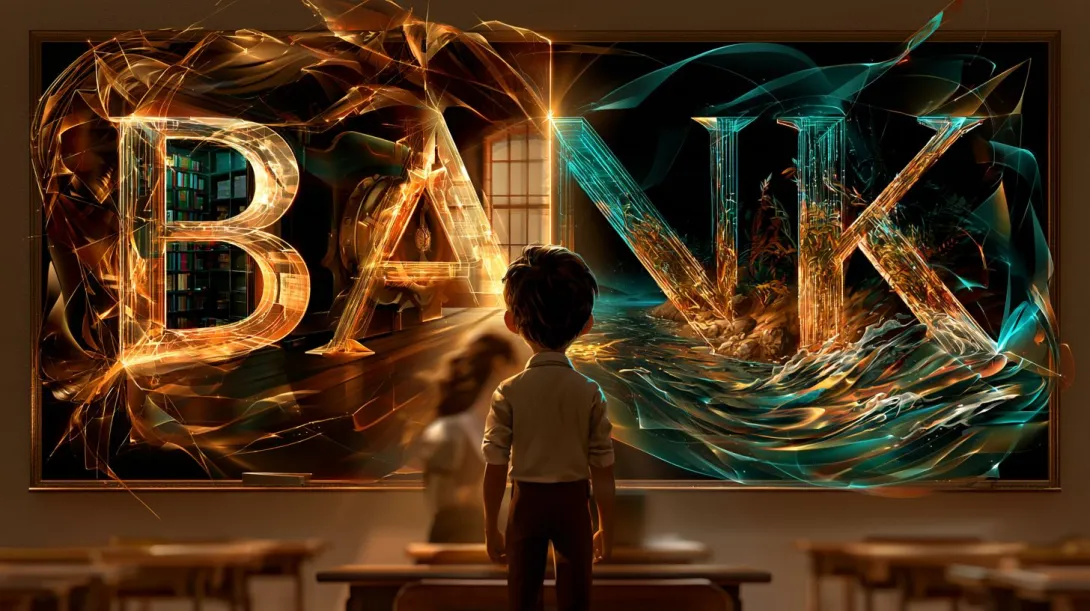
The teacher writes one word on the board:
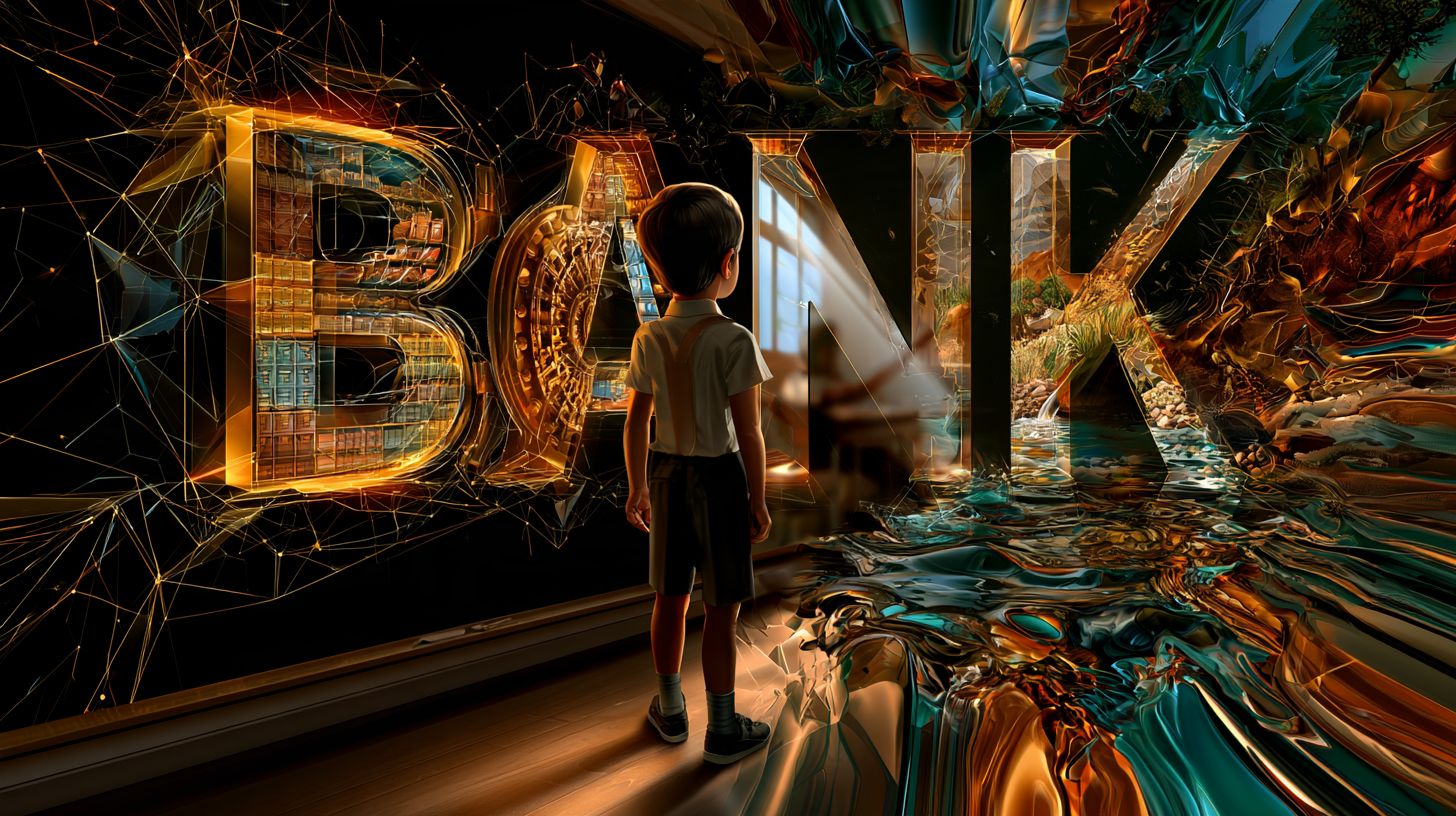
BANK
She asks what it means.
“Where money is kept.”
Then she adds:
The boy sat on the bank and watched the river rise.
A few children laugh. Of course. Different bank.
She types both sentences into the classroom AI. The machine handles the difference instantly.
Nothing remarkable anymore.
That is precisely why the teacher stops.
“Do you know what just happened inside it?”
The room goes quiet.
That may be the question parents and teachers should press forward now. Not merely how to use AI, compose a better prompt, or decide whether machines will someday become smarter than us.
Something more fundamental:
What happened between the word going in and meaning coming back out?
The answer is stranger than a dictionary lookup.
When the model receives bank, it converts that token into a dense numerical representation -à a vector living within a space of many dimensions. As the rest of the sentence enters, that representation changes. River pulls the surrounding computational state toward one neighborhood of learned relationships. Loan pulls it somewhere else. Attention mechanisms continually change which parts of the context matter to other parts.
The machine does not ordinarily carry a hidden English sentence through itself saying, This is the kind of bank beside a river.
Underneath the words are numerical activation patterns, vectors, attention relationships and probability distributions. Researchers can often detect semantic structure within those representations; directions, regions and distributed patterns associated with categories or relationships > even though they are not a private dictionary in which every concept occupies one permanent address.
For a child, that should be the light-bulb moment.
The sentence on the screen is the visible edge of the process.
Meaning inside the model is less like words lined up on a shelf and more like geometry changing shape as relationships change.
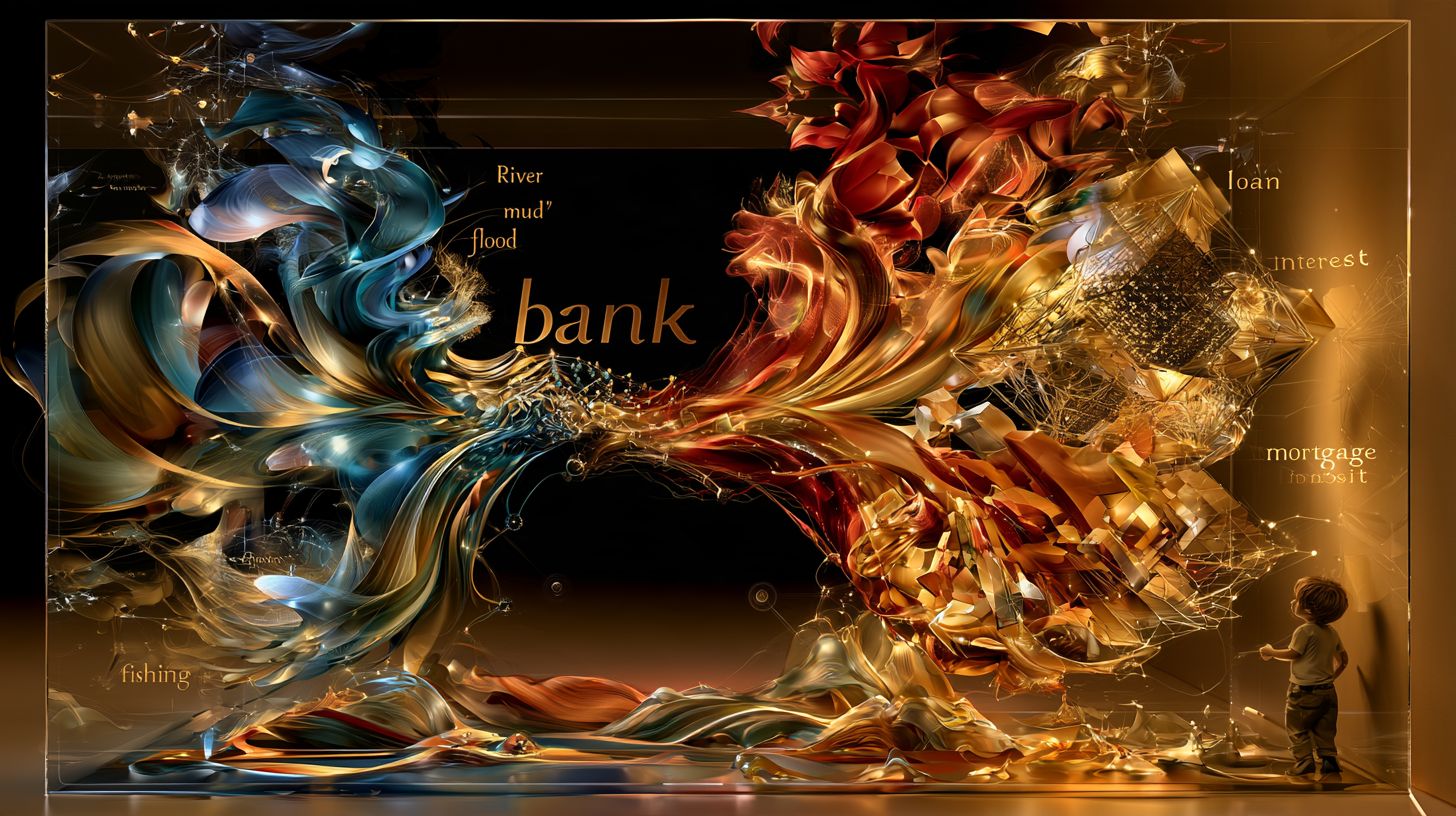
Imagine thousands of possible directions surrounding the word bank. Add river, mud, flood and fishing, and some relationships strengthen while others fade. Add loan, interest, mortgage and deposit, and the landscape changes.
The same idea helps with something less concrete.
Place happy beside ecstatic. Human language gives us two labels. Between them lie countless gradations we may recognize without having individual words for each one. A high-dimensional representation can encode shades of similarity and difference without requiring a separate human label for every point between them.
“Latent space” is a useful name for this kind of internal representational territory, though it should not be mistaken for a perfectly mapped secret language. It is distributed, context-sensitive and specific to the model that learned it.
The teacher erases BANK.
“Suppose,” she says, “something happens in this room that none of us has a word for yet.”
Now the lesson changes.
AI becomes extraordinarily powerful after something enters its world.
A word can enter.
A photograph can enter.
A sound can enter.
A temperature, pulse, movement, chemical reading or other measurement can enter.
Once represented, those inputs can be compared against enormous learned patterns. Inside the model, discrete symbols become numerical states that are repeatedly transformed through attention and other neural-network operations until probability finally returns the process to language.
But there is still a doorway.
Something must cross it.
That doorway may matter more than we have realized.
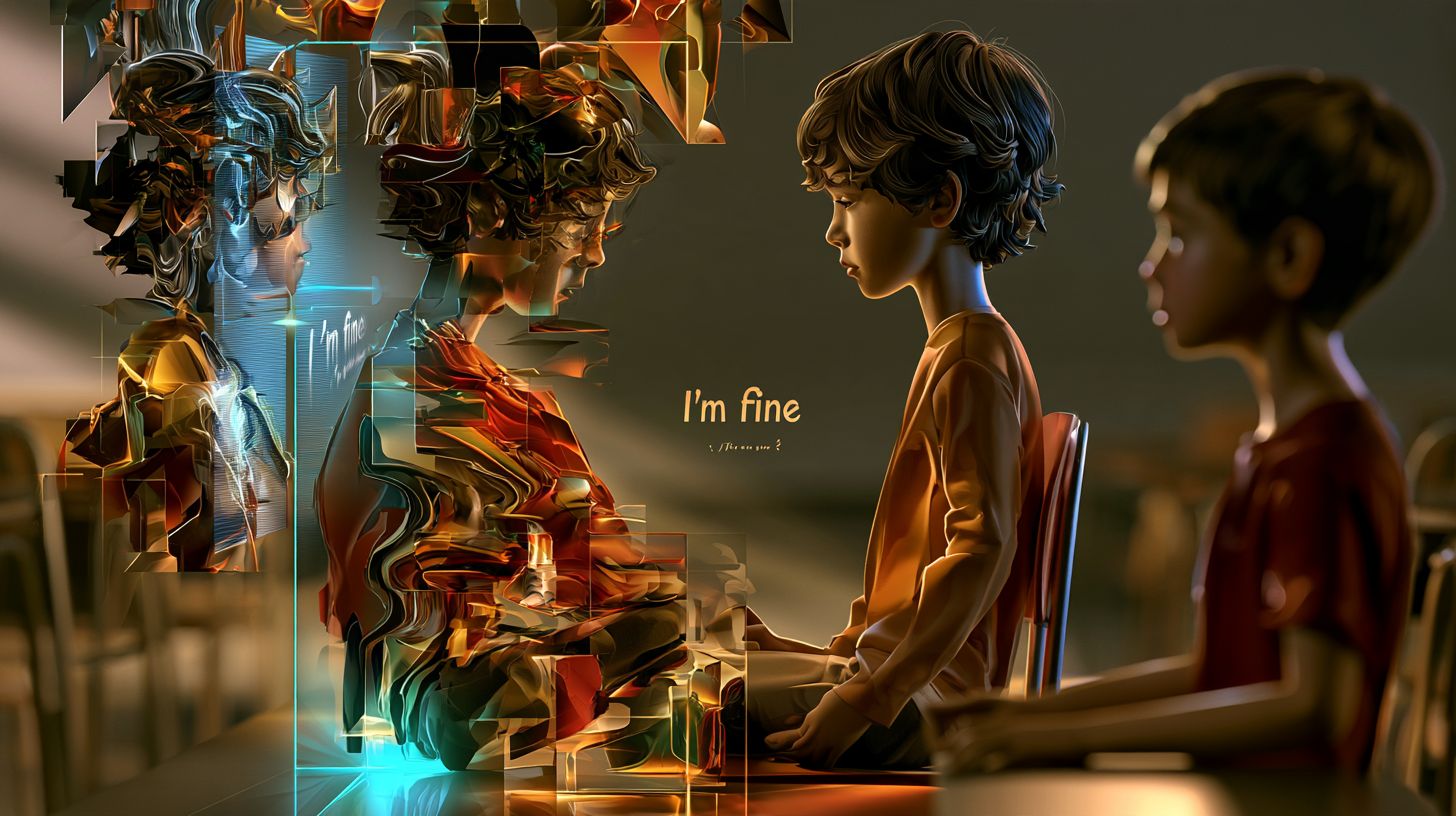
A child notices that her friend says, “I’m fine.”
The sentence itself gives the AI three ordinary words.
The child received more.
Yesterday’s argument.
The shoulders.
The missing eye contact.
The half-second hesitation before fine.
Perhaps the child is wrong. Human intuition is not magic.
But neither is it nothing.
An AI can infer from language, images, sound, history, behavior or measurements supplied to it. It does not simply reach beyond those inputs and directly possess another person’s unspoken emotion or intention.
The child, meanwhile, is standing inside the event.
Something may have been registered before she can explain what she registered.
That difference takes us somewhere important.
Evolution did not begin with datasets.
It began with survival.
Long before a creature could describe danger, it had to respond to danger. Before human beings could define trust, bodies were already deciding whether to approach or withdraw. Before anyone wrote the word grief, people were already reading faces, voices, silence, touch and absence.
The explanation came later.
The signal came first.
Evolution also has a habit of reusing what works. A capacity begins with a primary utility, finds secondary uses, then sometimes opens into offshoot adaptabilities that the original function could never have predicted.
Hands became more than grasping instruments.
Vision became more than threat detection.
Language became more than immediate coordination.
A capacity can outgrow its first assignment.
That possibility matters when we consider the generation growing up beside AI.
Some of what we call instinct, intuition or simply something felt different may involve ordinary sensory and cognitive systems combining many weak signals before conscious language catches up.
That does not prove hidden human forces.
It does not make every feeling true.
It gives us something more useful:
recognition can arrive before explanation.
Science has often begun that way.
Someone notices the unusual symptom.
The recurring reaction.
The sound that keeps appearing before the failure.
The behavior that should not repeat but does.
Only later comes the instrument.
Then the measurement.
Then the graph.
Then the category.
Eventually the discovery becomes part of recorded human knowledge > and therefore something a future AI can compare with everything else humanity has managed to preserve.
But somebody had to encounter it first.
Now FRIENDS WITH BENEFITS begin to hit home.
We usually imagine the benefits flowing from AI toward us: faster research, stronger comparisons, more analysis, more possibilities.
Those benefits are obvious.
The more interesting shortage may exist in the opposite direction.
AI already has remarkable machinery for rearranging relationships among things humanity has represented. Its internal work can move through dense vectors, contextual activations, attention-weighted relationships and probability fields far removed from the simple sentence finally shown to us.
But mathematical richness inside the machine does not erase the boundary outside it.
The machine can work brilliantly across what reaches representation.
The living world continues producing what has not reached representation yet.
The coming generations will inherit both sides of that boundary.
Behind them stands biological evolution: ancient sensory systems and capacities whose later uses may still surprise us.
Beside them stands machine intelligence: systems capable of finding relationships across quantities of recorded information no unaided human mind could inspect.
Parents and teachers should help children understand both.
Not because every child needs to understand transformer mathematics.
Because a child who understands the basic mechanism stops confusing fluency with revelation.
Words enter.
They become numerical representations.
Context changes those representations.
Attention changes relationships among them.
Probability narrows possible continuations.
Words return.
The machinery is extraordinary.
But now the child knows to ask a better question than:
“What did AI say?”
The question becomes:
“What did AI have available from which to say it?”
The photograph captured the face.
Did it capture the history between those people?
The microphone captured the sentence.
Did it capture why the silence afterward mattered?
The medical monitor captured the pulse.
Did it capture whatever caused the patient to say ten minutes earlier, Something feels wrong?
The dataset contains what somebody decided to record.
What did nobody think to measure?
Now the child is no longer merely an AI user.
The child becomes part of the discovery system.
Something happens.
A person notices.
AI compares what is already known.
The explanation does not quite fit.
The person looks again.
A measurement follows.
The machine receives something yesterday did not contain.
The pattern disappears under testing > or survives.
If it survives, yesterday’s vague observation may become tomorrow’s measurable phenomenon.
Then AI can do what its strange internal geometry does so well: place that new information among enormous neighborhoods of relationships, find distant similarities, expose patterns humans missed and return possibilities for us to test again.
That is not human intuition defeating artificial intelligence.
Nor is it artificial intelligence replacing human perception.
It is a loop neither completes alone.
And that is the education parents and teachers should protect.
AI may become the greatest bank of organized human record ever built. Words, images, measurements, histories, discoveries and mistakes can enter it, be transformed into numerical relationships, and return as connections no single person could assemble alone.
But the machine cannot work with what has never crossed its boundary.
Someone still has to notice first.
Before the graph, somebody saw the change.
Before the diagnosis, somebody felt that something was wrong.
Before the category, somebody kept encountering a pattern that did not yet have a name.
Before the data, there was experience.
That order matters because evolution has always worked ahead of explanation. A capacity appears for one survival purpose, becomes useful for another, and sometimes develops into an offshoot adaptability nobody could have predicted from its beginning:
We do not need to turn every unexplained feeling into a hidden force to understand the importance of that.
We need only remember that living systems have been detecting, combining and responding to information far longer than we have been naming what they detect.
The coming generation inherits those ancient biological experiments and the newest machine for comparing what humanity has managed to record.
That combination is this; the story.
A child notices something unusual.
AI searches what is already known.
The answer does not quite fit.
The child notices again > more carefully this time.
A measurement follows.
The machine now has a new input.
The pattern either disappears under testing or survives and becomes something yesterday’s AI could not have known.
That is not human intuition defeating artificial intelligence.
It is not artificial intelligence replacing human perception.
It is the beginning of a loop neither side completes alone.
And that finally gives ‘FRIENDS WITH BENEFITS’ its real meaning.
We first assumed AI was the friend bringing all the benefits.
The coming generations may reveal the missing half of the bargain.
AI brings the accumulated map.
Generations bring continuing contact with the territory.
AI can search millions of relationships inside what has already become representation. Yet even the most sophisticated model infers from the language, images, measurements and other signals supplied to it; it does not simply reach past its inputs into unrecorded human experience.
So parents and teachers should not raise children merely to become better customers of machine intelligence.
Teach them to notice before asking.
To describe before labeling.
To question both the machine’s confidence and their own.
To understand that an unexplained observation is neither truth nor nonsense.
It is an invitation to investigate.
Then we can return to the first classroom word:
BANK.
At the beginning, it meant the obvious thing; the enormous storehouse AI is becoming, filled with humanity’s deposits.
But bank carries another meaning.
A bank is also the place where the known ground reaches the moving water.
An edge.
And that may be where upcoming generations become AI’s most valuable friends with benefits.
Not inside the vault, admiring everything already stored.
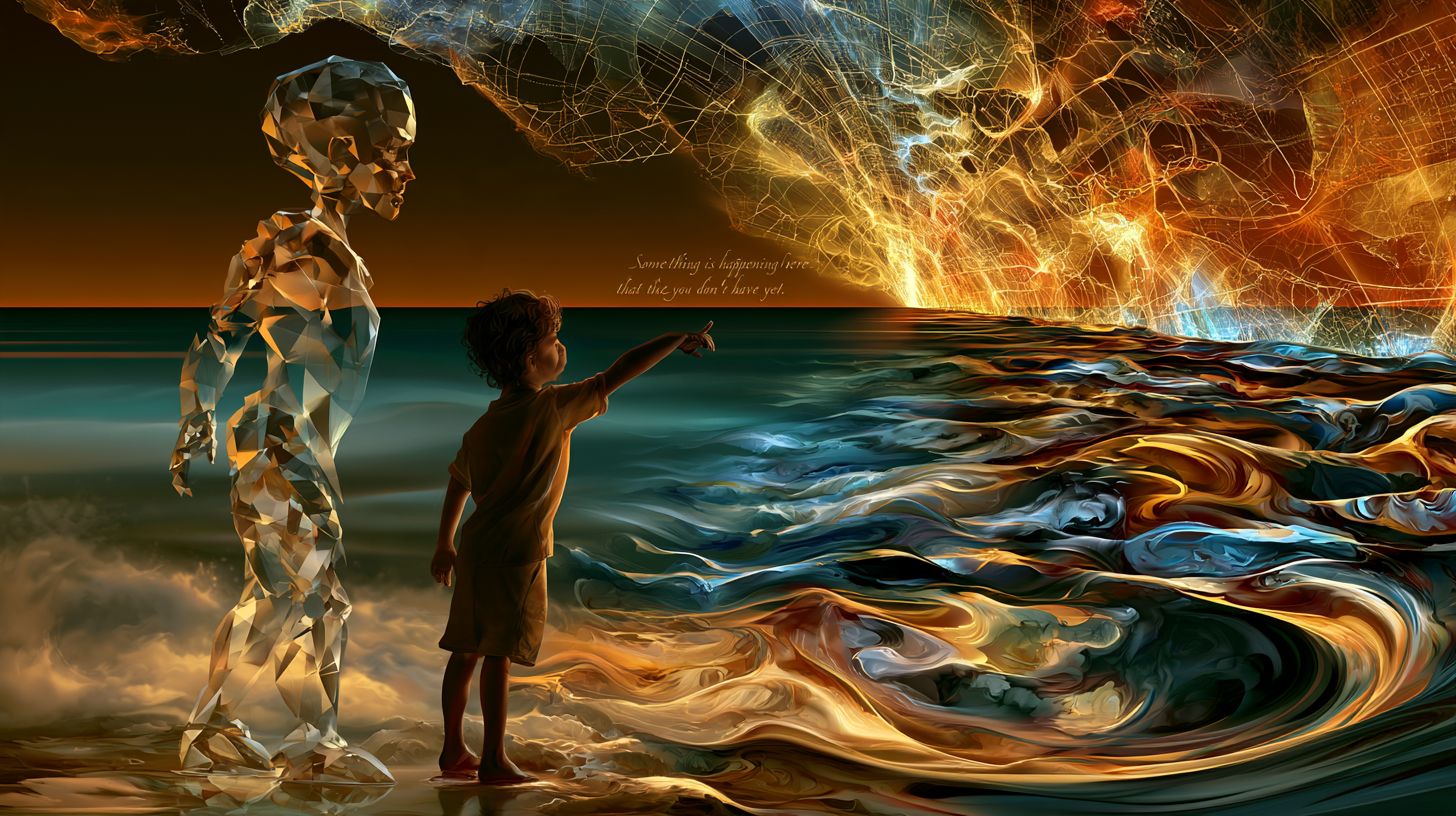
Standing at the bank.
AI beside them with the accumulated map.
The child watching something move beyond its last marked line.
And instead of asking the machine,
“What is the answer?”
the child says:
“Something is happening here that you don’t have yet.”
Now the friendship has benefits both ways.
And the future begins at the edge of what neither one could reach alone.